When Did Protecting Our Skin Become Something to Fear?
We live in a time when information is everywhere, yet understanding can sometimes feel increasingly difficult.
One day, we hear that sunscreen is one of the most important products in our skincare routine. The next, we encounter someone claiming that its ingredients are toxic, interfere with our hormones, or may even cause cancer.
Naturally, this raises questions.
Should we be concerned about what we apply to our skin? Are sunscreen ingredients truly safe? And how do we distinguish legitimate scientific concerns from misinformation?
These are reasonable questions, and they deserve thoughtful answers.
At NUKVAH, we believe that understanding skincare is just as important as practicing it. Our skin is a remarkable organ, and learning how to care for it begins with understanding what science actually tells us.
So, rather than approaching sunscreen with fear or unquestioning confidence, let’s explore the evidence.
01
The Sun: Essential to Life, but Not Without Risks
Sunlight is fundamental to life.
It influences our biological rhythms, contributes to our sense of well-being, and allows our bodies to produce vitamin D through exposure to ultraviolet B radiation.
But something can be essential to life and still require moderation.
The sun emits ultraviolet radiation, including two types particularly relevant to skin health:
- UVA radiation penetrates more deeply into the skin and contributes to premature skin aging, pigmentation changes, and skin cancer risk.
- UVB radiation is primarily responsible for sunburn and can directly damage the DNA of skin cells.
Over time, repeated ultraviolet exposure can contribute to wrinkles, uneven pigmentation, loss of skin elasticity, and the development of skin cancer.
This damage is not always immediately visible. Some effects accumulate gradually, long before we notice changes in the mirror.
Sunscreen was developed to help reduce these effects by limiting the amount of ultraviolet radiation reaching the skin.
Protecting our skin does not mean avoiding the sun. It means understanding how to enjoy sunlight responsibly.
02
Does Sunscreen Really Help Prevent Skin Cancer?
This is one of the most important questions in the entire conversation.
Ultraviolet radiation is a well-established cause of skin cancer. Reducing excessive exposure is therefore a central part of prevention.
Scientific research supports the use of sunscreen as one of the tools available to accomplish this.
A randomized Australian study, published in the Journal of Clinical Oncology in 2011, examined the long-term effects of regular sunscreen application.
Researchers followed participants who had been assigned to daily or discretionary sunscreen use. During follow-up, they observed 11 new primary melanomas in the daily sunscreen group, compared with 22 in the discretionary-use group.
The difference in total melanomas narrowly missed conventional statistical significance, while the reduction in invasive melanoma was statistically significant [1].
The findings provided encouraging evidence that regular sunscreen use may help prevent melanoma.
Sunscreen is not a perfect shield, nor should it replace shade, protective clothing, or other sensible sun-protection habits.
But the evidence supporting protection against excessive ultraviolet exposure is substantial.
And this leads us to an interesting question: if sunscreen offers important benefits, why has it become the subject of so much suspicion?
03
Why Do Some People Believe Sunscreen Is Harmful?
The controversy surrounding sunscreen did not emerge from a single source.
Some concerns originated in scientific studies examining how certain sunscreen ingredients interact with the body.
Researchers have investigated whether particular ultraviolet filters can penetrate the skin, enter the bloodstream, or demonstrate hormonal activity under experimental conditions.
These investigations are important. Scientific progress depends on questioning established practices and continually examining safety.
However, there is a significant difference between identifying a possible biological effect and demonstrating that something causes harm during normal human use.
For example, some studies have detected sunscreen ingredients in the bloodstream after topical application.
This finding deserves further investigation, but it does not automatically establish toxicity.
In toxicology, scientists consider several factors, including the amount of exposure, the biological response, the duration of exposure, and whether the findings are relevant to real-world human conditions.
The presence of a substance in the body does not, by itself, demonstrate that the substance is causing damage.
The U.S. Food and Drug Administration has requested additional safety information for several sunscreen ingredients [3].
Importantly, requesting more information is not the same as declaring those ingredients unsafe.
Science is a continuous process. Responsible conclusions must reflect both what is known and what remains uncertain.
04
What Does Europe Say About Sunscreen Ingredients?
When discussing cosmetic ingredient safety, the European Union offers an important perspective.
Europe operates under a comprehensive cosmetic regulatory framework that includes ingredient restrictions, concentration limits, and scientific safety assessments.
The United States uses a different regulatory system, treating sunscreen as an over-the-counter drug rather than a cosmetic [3].
Although these systems cannot simply be ranked as universally stricter or more permissive, European scientific assessments provide valuable information about ingredient safety.
One example is octinoxate, also known as Ethylhexyl Methoxycinnamate, a UV filter commonly used in sunscreen formulations.
This ingredient has received attention because laboratory and animal studies have identified potential endocrine-related activity.
In June 2025, the European Commission’s Scientific Committee on Consumer Safety (SCCS) issued its final scientific opinion on octinoxate [2].
The committee examined the available evidence, including concerns about hormonal activity, and concluded that octinoxate is safe for use as a UV filter in sunscreen products at concentrations up to 10%, under the evaluated conditions.
This conclusion is particularly meaningful because the scientific committee did not ignore the concerns. It evaluated them as part of its safety assessment.
Does this mean that every product containing octinoxate is automatically safe in every circumstance?
Not necessarily. Finished-product safety also depends on formulation, intended use, exposure, and other relevant factors.
However, the European assessment provides an important example of how scientists distinguish experimental findings from real-world safety conclusions.
A potential hazard is not automatically the same as a demonstrated risk. Understanding that difference is essential to making informed skincare decisions.
05
Mineral Sunscreen vs. Chemical Sunscreen: Is One Safer?
The terms mineral and chemical are frequently used to describe different types of sunscreen.
Mineral sunscreens generally use zinc oxide or titanium dioxide as ultraviolet filters.
Organic sunscreens, often referred to as chemical sunscreens, use filters such as avobenzone, octinoxate, or octisalate.
Some formulations combine mineral and organic filters.
Despite popular explanations suggesting otherwise, both mineral and organic filters work primarily by absorbing ultraviolet radiation. Mineral filters can also reflect and scatter a portion of it.
The distinction between these categories does not automatically determine whether a sunscreen is safe or effective.
Mineral formulations may be preferable for some individuals with sensitive skin. Other people may find organic or combination formulas more comfortable, particularly when considering texture and cosmetic appearance.
What matters is choosing a product with appropriate, substantiated sun protection that suits your skin and encourages consistent use.
A sunscreen that feels comfortable enough to use regularly can be an important part of maintaining a healthy skincare routine.
06
Does Sunscreen Prevent Vitamin D Production?
Vitamin D is essential for bone health and other physiological functions.
Because UVB radiation stimulates vitamin D production in the skin, some people question whether wearing sunscreen interferes with this natural process.
Under controlled conditions, sunscreen can reduce the UVB radiation reaching the skin.
However, studies of sunscreen use in everyday life have not consistently demonstrated that regular application leads to vitamin D deficiency.
Factors such as diet, geographic location, skin pigmentation, age, health conditions, and individual sun exposure also influence vitamin D status.
For people concerned about maintaining adequate vitamin D levels, dietary sources and medically appropriate supplementation offer alternatives to intentional unprotected UV exposure.
We do not have to choose between protecting our skin and supporting our overall health.
07
Are Natural Ingredients Always Safer?
The growing interest in clean beauty has encouraged many consumers to become more conscious of the products they use.
This curiosity is valuable. Reading labels, understanding formulations, and asking questions can lead to better decisions.
However, the word natural does not automatically mean safe, just as synthetic does not automatically mean harmful.
Nature contains substances that can irritate the skin, trigger allergies, or cause toxicity. Likewise, many laboratory-produced ingredients have well-established safety profiles under appropriate conditions of use.
Safety depends on the substance, concentration, formulation, exposure, and individual response.
Even sunscreen products considered appropriate for general use may cause irritation or allergic reactions in certain individuals.
The goal should not be to fear unfamiliar ingredient names.
It should be to understand why ingredients are used, how they have been evaluated, and whether the finished product is appropriate for our needs.
●●●
Knowledge is more valuable than a reassuring label.
08
Why Does Sunscreen Misinformation Spread So Easily?
There is something powerful about a message that claims to reveal a hidden danger.
When someone confidently declares that a familiar product is harmful, it naturally attracts attention.
Social media can amplify these messages, particularly when complex scientific findings are reduced to dramatic statements.
A laboratory observation may become a headline about toxicity. A request for additional research may be interpreted as proof that an ingredient is dangerous. An environmental concern may be confused with a demonstrated human health risk.
But scientific understanding rarely fits into a single dramatic sentence.
It requires context, careful interpretation, and the willingness to acknowledge uncertainty.
This does not mean consumers should blindly trust every product or every manufacturer.
Healthy skepticism is important.
But skepticism should apply equally to the claims that reassure us and those that frighten us.
Before accepting a statement about sunscreen, it is worth asking:
- Was the research conducted in humans, animals, or laboratory cells?
- Were the exposure levels comparable to ordinary sunscreen use?
- Did the study identify a possible biological effect or demonstrate actual harm?
- What have independent scientific and regulatory organizations concluded?
These questions help us move beyond fear toward a more meaningful understanding of skincare.
09
Sunscreen and the Philosophy of Conscious Skincare
At NUKVAH, we believe skincare should be an expression of awareness, not anxiety.
Our skin changes throughout life. It responds to our environment, our habits, our health, and the passage of time.
Caring for it does not mean trying to stop every natural change.
It means recognizing that our daily choices can influence how we protect and support its health.
Sun protection is one of those choices.
Dermatologists generally recommend broad-spectrum, water-resistant sunscreen with SPF 30 or higher, used alongside shade and protective clothing [4].
Applying sunscreen generously, following product directions, and reapplying during prolonged outdoor exposure are important parts of effective protection.
A thoughtful skincare ritual does not need to be complicated.
It needs to be consistent, appropriate for your skin, and supported by reliable information.
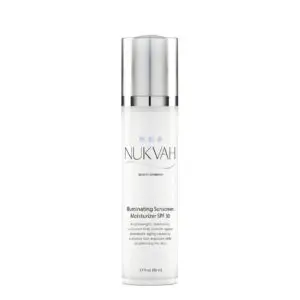
At NUKVAH, our Illuminating Sunscreen Moisturizer SPF 30 reflects our interest in bringing daily sun protection and moisturizing skincare together in a simple routine.
But beyond any individual product, our message remains the same: understanding your skin is one of the most meaningful ways to care for it.
Final Thoughts: Beauty Begins With Understanding
Perhaps the most important lesson in the sunscreen conversation is not about a single ingredient.
It is about how we choose to understand the world around us.
Science does not ask us to believe without questioning. It asks us to investigate, evaluate evidence, and remain open to new discoveries.
The evidence supporting protection against excessive ultraviolet exposure is strong. At the same time, continued research into sunscreen ingredients helps improve scientific understanding and consumer safety.
These ideas are not contradictory.
We can appreciate the benefits of sunscreen while supporting ongoing scientific investigation.
We can enjoy sunlight while recognizing the importance of protecting our skin.
And we can make conscious skincare choices without allowing fear to determine them.
At NUKVAH, we believe beauty is not simply about what we see in the mirror. It is also about the awareness we develop, the knowledge we gain, and the respect we show ourselves through the choices we make.
Because when we understand our skin, we learn to care for it with greater confidence.
NUKVAH — Beauty Awakened.
Scientific references
- Green, A. C., et al. (2011). Reduced melanoma after regular sunscreen use: Randomized trial follow-up. Journal of Clinical Oncology, 29(3), 257–263. pubmed.ncbi.nlm.nih.gov/21135266/
- European Commission, Scientific Committee on Consumer Safety (2025). Opinion on Ethylhexyl Methoxycinnamate (EHMC). SCCS/1671/24. health.ec.europa.eu/publications/sccs-opinion-ethylhexyl-methoxycinnamate-ehmc-cas-no-5466-77-383834-59-7-ec-no-226-775-7629-661-9_en
- U.S. Food and Drug Administration. Questions and Answers: FDA’s Regulatory Actions on Over-the-Counter Sunscreen. fda.gov/drugs/understanding-over-counter-medicines/questions-and-answers-fdas-regulatory-actions-over-counter-sunscreen
- American Academy of Dermatology. How to Decode a Sunscreen Label. aad.org/public/everyday-care/sun-protection/shade-clothing-sunscreen/understand-sunscreen-labels