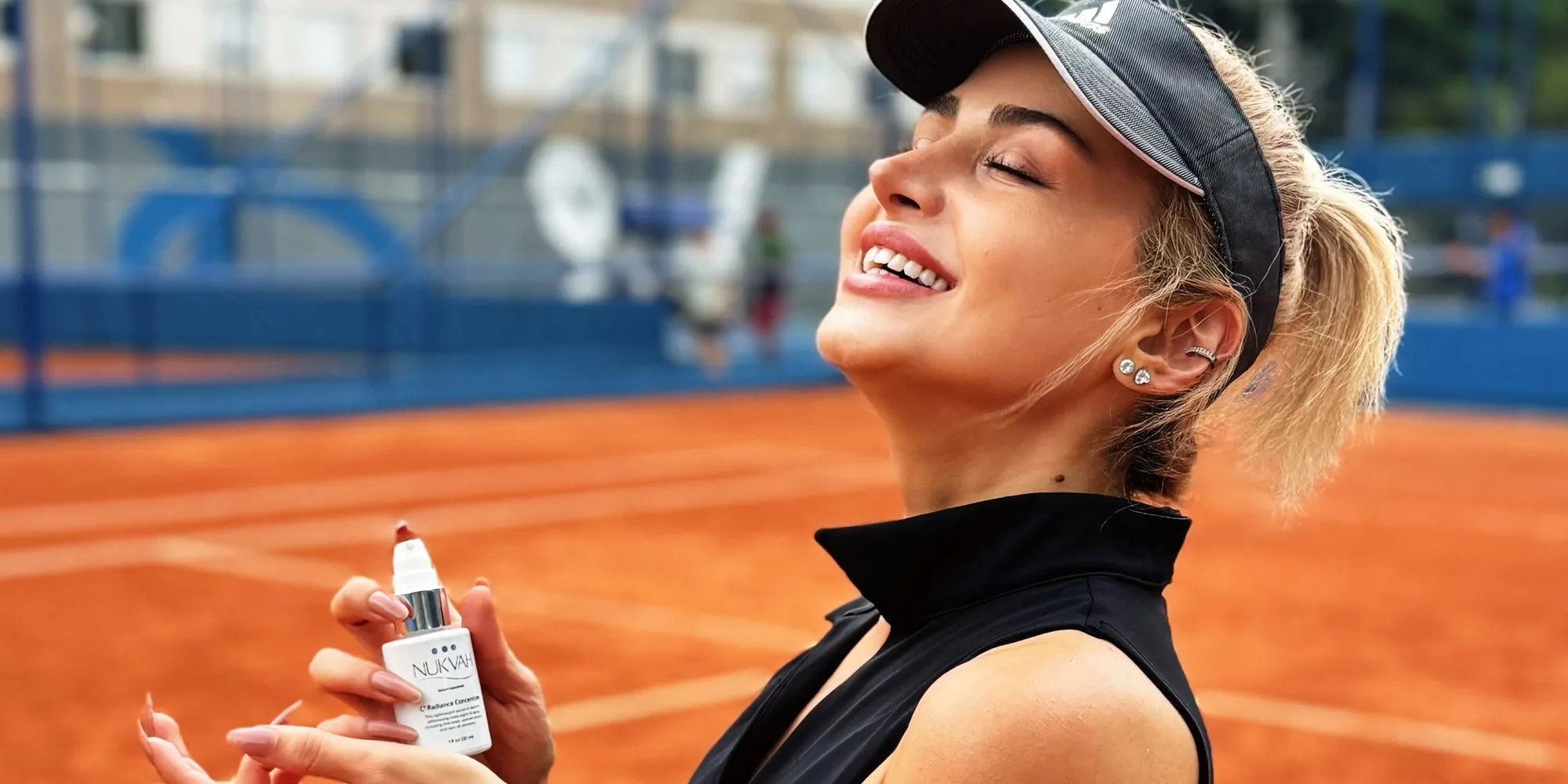
Beauty Awakened
We live in a world that insists beauty is not important, yet behaves as though it is.
We praise inner beauty while investing extraordinary amounts of time and money in preserving the outer one. We criticize vanity while admiring youth. We tell women that age is just a number, yet celebrate them when they look younger than that number suggests.
Perhaps the hypocrisy is not in caring about beauty.
Perhaps it is in pretending we don’t.
But what if our desire to remain beautiful is revealing something far more interesting than our relationship with the mirror?
What if it is also revealing our relationship with life itself?
The Generation That Seems to Have Changed the Face of Aging
Look at a photograph of a forty-year-old woman from several decades ago. Then look at a forty-year-old woman today.
Something often appears different.
Women in their forties today may look remarkably youthful compared with our mental image of women of the same age in previous generations. The same impression can occur when comparing people in their sixties or seventies.
We might immediately attribute this to Botox, fillers, cosmetic procedures, or advances in skincare.
But that explanation is incomplete.
There are women who have never undergone an aesthetic procedure, never altered their facial features, and yet appear younger than we might expect.
What changed?
Is it simply better healthcare, greater knowledge of sun exposure, nutrition, and preventive habits?
Or is there another dimension we have not fully explored?
Scientific research offers an intriguing starting point. In a study published in The Journals of Gerontology, researchers examined how people judged the age of identical photographs over time. They found that age perception had shifted significantly between 2002 and 2012. In 2012, people over seventy needed to look 2.3 years younger to be rated the same age as in 2002. [1]
The study did not establish that modern forty-year-olds look fifteen years younger than previous generations. It demonstrated something more subtle: even our perception of what a particular age should look like can change.
Perhaps the transformation is happening in two places simultaneously: in the way we live and in the way we understand aging.
And that possibility deserves more than a superficial explanation.
Have We Become More Conscious of How We Live?
Previous generations lived under different social expectations, working conditions, medical limitations, and cultural pressures.
Today, more people have access to information about physical health, emotional well-being, and the long-term consequences of daily habits.
We speak openly about trauma, boundaries, emotional intelligence, purpose, and the importance of understanding ourselves.
But access to information does not automatically make us wiser.
A person can know everything about wellness and still live in constant conflict with themselves.
So perhaps the more important question is not how much we know, but what we do with that knowledge.
Are we becoming more conscious of our choices?
Are we learning to recognize what we genuinely desire instead of living according to what others expect?
Are we beginning to understand that every action has consequences, not only for ourselves but also for the people around us?
And could this awareness influence our physical and emotional vitality?
These questions do not yet have one definitive scientific answer. But they lead us toward an important relationship: the connection between the mind, the body, and the way we experience life.
The Invisible Weight We Carry
Imagine two people living through similar circumstances.
One remains trapped in resentment, constantly revisiting past offenses, measuring personal worth through comparison, and reacting to every disappointment.
The other experiences frustration, sadness, and conflict too, but gradually learns to recognize these emotions without allowing them to dictate every decision.
Neither person is immune to suffering.
Neither is guaranteed a longer life or a younger appearance.
But their daily emotional experiences may be profoundly different.
Science has established that prolonged psychological stress can affect physiological systems involved in hormonal regulation, immunity, and inflammation.
Research has also investigated associations between psychological stress and telomere length, one of several markers studied in relation to cellular aging. [2] These findings are complex and do not prove that a peaceful mind prevents wrinkles or reverses biological age.
Still, they challenge the idea that our emotional lives exist independently of our bodies.
Perhaps we should be more curious about what happens when emotional reactions become permanent patterns.
Not because anger makes a woman old.
Not because sadness diminishes her beauty.
But because learning to respond consciously, rather than living at the mercy of every impulse, may change the quality of the life she experiences.
What Ancient Wisdom Understood About Vitality
Long before modern science began examining the biological effects of stress, biblical wisdom was already inviting humanity to consider the relationship between inner life and outward expression.
Proverbs 15:13 says:
●●●
“A merry heart maketh a cheerful countenance.” [3]
There is something remarkably observant in these words.
Our faces communicate more than chronological age. They communicate emotion, expression, and the experiences of the present moment.
In Psalm 103:5, we encounter the beautiful image of youth being renewed like the eagle’s.
Isaiah 40:31 speaks of those who wait upon the Lord renewing their strength.
These passages are not scientific formulas for preventing aging. They express a spiritual understanding of renewal, joy, and the strength that comes from a connection beyond our immediate circumstances.
They also invite a distinction we often overlook.
Being young and feeling renewed are not necessarily the same thing.
Youth belongs to a stage of life.
Renewal may be experienced at many stages.
A person can be chronologically young and feel exhausted by existence. Another can be considerably older and remain curious, purposeful, engaged, and enthusiastic about living.
Perhaps vitality should never have been measured by appearance alone.
Kabbalah and the Intelligence of Desire
Kabbalah introduces a profound question about human existence: are we masters of our desires, or have we become servants to them?
The desire to receive, to experience pleasure, to be recognized, to feel loved, or to possess something beautiful is deeply human.
Desire itself is not necessarily the problem.
What deserves examination is what happens when desire becomes disconnected from awareness, responsibility, and consideration for others.
Consider the desire to be beautiful.
A woman may care for her skin because she appreciates beauty, enjoys her daily rituals, and wants to preserve her health and appearance.
Another may pursue the same routine because she believes that without youth, she will lose her value.
The actions may appear identical.
But the inner motivations are entirely different.
One may be an expression of appreciation.
The other may be driven by fear.
Kabbalah offers a framework for reflecting on the relationship between receiving and giving, between impulse and conscious choice.
Its teachings invite us to examine the ego—not simply as confidence or individuality, but as the tendency to place our immediate desires at the center of every experience.
In this philosophical context, restraint becomes an expression of freedom.
The freedom not to react to every provocation.
The freedom not to turn every disagreement into a battle.
The freedom to recognize a desire without automatically surrendering to it.
This does not mean suppressing emotion or abandoning personal ambition.
It means asking whether our choices are governed by awareness or by unconscious patterns.
And perhaps this is one of the most interesting questions we can bring into the conversation about aging:
How much of our energy is spent living, and how much is spent fighting everything we cannot control?
We cannot claim that overcoming ego biologically reverses aging. But we can ask whether a life shaped by greater self-awareness might also become a life experienced with greater vitality.
The Difference Between Looking Young and Remaining Alive Within
We have become extraordinarily skilled at examining the visible signs of aging.
We study wrinkles, pigmentation, collagen, skin elasticity, and cellular changes.
But what about the invisible signs of disengagement from life?
When did we stop being curious?
When did we begin treating every new experience as a threat?
When did protecting our comfort become more important than discovering what we might still become?
There is a kind of vitality that cannot be purchased in a bottle or measured in a photograph.
It appears in the willingness to learn, to reconsider an opinion, to forgive without denying what happened, and to pursue meaningful goals without needing the approval of everyone around us.
This is not a substitute for physical health.
It is another dimension of living.
And perhaps we should stop confusing the absence of wrinkles with the presence of vitality.
Beauty Was Never the Enemy
We do not need to apologize for wanting to be beautiful.
We do not need to pretend that physical appearance is irrelevant to human experience.
Beauty can inspire appreciation, pleasure, creativity, and connection.
But when beauty becomes our only source of validation, we give something external the authority to determine our worth.
The challenge is not to stop caring about appearance.
It is to understand why we care.
There is nothing contradictory about appreciating science, using skincare, enjoying aesthetic treatments, and simultaneously cultivating spiritual depth.
A woman can desire beautiful skin without believing that aging makes her less valuable.
She can invest in her appearance without making it the center of her identity.
She can recognize her beauty without demanding that others confirm it.
Perhaps true self-awareness begins when we stop dividing ourselves into opposing categories: the physical and the spiritual, the beautiful and the intelligent, the ambitious and the compassionate.
We are not required to abandon one dimension of ourselves to honor another.
What If We Have Been Searching in the Wrong Place?
Maybe we have spent too much time asking why some people appear younger than their age and too little time asking how they experience the years they have been given.
What motivates them to wake up each morning?
What gives meaning to their choices?
How do they respond when life refuses to follow their expectations?
What have they learned to release?
And what do they still have the courage to pursue?
These questions cannot reveal someone’s biological age. They cannot explain every youthful face, and they should never become a way to judge people whose health or appearance has been affected by circumstances beyond their control.
But they can expand the conversation.
Because perhaps the greatest mistake is believing that preserving youth and cultivating wisdom are unrelated pursuits.
One concerns the passage of time.
The other concerns what we do with it.
And both deserve our attention.
The Real Hypocrisy
We say beauty does not matter, yet we continue searching for it.
We say age is just a number, yet we allow that number to define what we believe is possible.
We say we want to live longer, yet sometimes spend our days consumed by conflicts that contribute little to the life we claim to value.
Perhaps the greatest contradiction is not our desire to remain young.
It is our willingness to invest so much in preserving the appearance of life while neglecting to examine how deeply we are actually living it.
What if we began asking different questions?
Not only, How can I look younger?
But also, What am I doing with the life I have today?
Not only, What should I apply to my skin?
But also, What am I allowing to shape my thoughts, decisions, and relationships?
Not only, How can I preserve my beauty?
But also, Do I understand what beauty means to me?
At NUKVAH, we believe in the beauty of a woman being herself.
Not a woman without desires, imperfections, or contradictions.
But a woman willing to understand them.
Because perhaps beauty was never meant to be separated from consciousness.
And perhaps the most meaningful form of renewal begins when we stop living automatically and start choosing deliberately.
We cannot stop time. But we can become more conscious of the life we place within it.
NUKVAH — Beauty Awakened.
References
- Steiner, U. K., Larsen, L. A., & Christensen, K. (2020). Parallel Progress in Perceived Age and Life Expectancy. The Journals of Gerontology: Series A. pmc.ncbi.nlm.nih.gov/articles/PMC7530473/
- Epel, E. S., et al. (2004). Accelerated telomere shortening in response to life stress. Proceedings of the National Academy of Sciences, 101(49), 17312–17315. doi.org/10.1073/pnas.0407162101
- Biblical references: Proverbs 15:13; Psalm 103:5; Isaiah 40:31 (King James Version).
- American Academy of Dermatology Association. 11 Ways to Reduce Premature Skin Aging. aad.org/public/everyday-care/skin-care-secrets/anti-aging/reduce-premature-aging-skin
- National Institute on Aging. Skin Care and Aging. nia.nih.gov/health/skin-care/skin-care-and-aging
A note on this article
The spiritual and philosophical interpretations in this article are distinct from the scientific findings. Current research does not establish that spiritual practice, emotional restraint, or self-awareness directly reverses biological aging or guarantees a younger appearance.